
Visual timer for ADHD
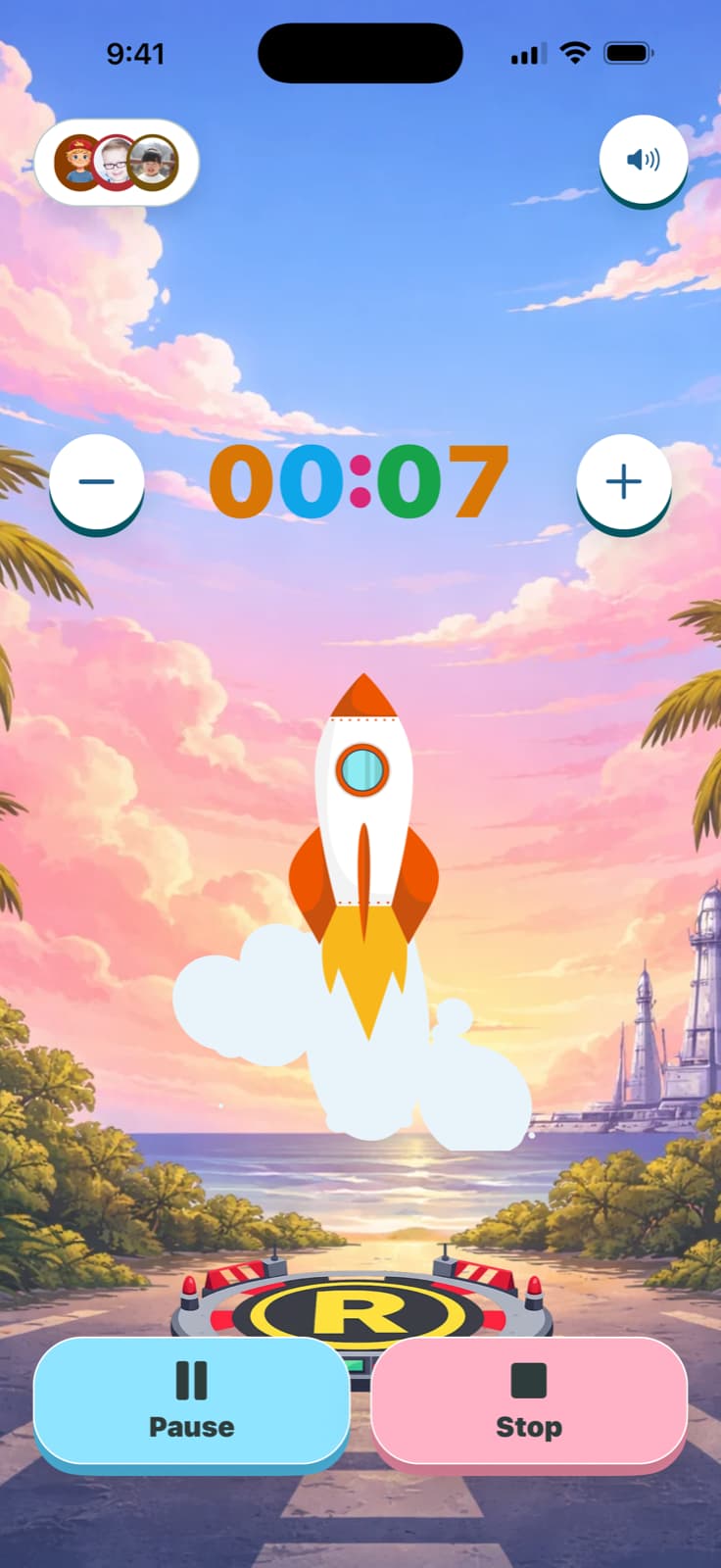
A timer that makes time visible for kids with ADHD.
TickTod turns the invisible countdown into something a child can watch and understand. No noise unless you want it. No clutter. Just visible time.
 Download TickTod free
Free for iPhone and iPad · No account required

Why visual time matters
ADHD and time, without the overclaiming.
Difficulty judging how long something takes is one of the more consistently measured features of ADHD. A visual timer does not fix that, but it does remove the need to estimate.
What research shows
A meta-analysis of 55 studies found people with ADHD were measurably less accurate at telling durations apart and reproducing them, with medium effect sizes. Estimating "five minutes" can be genuinely harder.
What a visual timer does
It replaces the estimate with something visible. Your child can glance at the fill and see how much is left, instead of tracking an interval in their head.
What actually carries the routine
Evidence suggests a warning by itself changes little. What matters is that the finish is consistent. Presets and a repeatable ending are the part TickTod is built to make easy.
Built for your child
Features you can tune to the child in front of you.

Give your child a timer they can actually see.
Free on iPhone and iPad. No account required to get started.
 Get it on the App Store
Common questions
Why do many kids with ADHD find time hard to judge?
Differences in how time is perceived are one of the more consistently measured features of ADHD. A 2022 meta-analysis in the Journal of the American Academy of Child and Adolescent Psychiatry pooled 55 studies and found people with ADHD were less accurate at discriminating and reproducing durations, with medium effect sizes in both. That does not describe every child, but it does mean "five more minutes" can be genuinely harder to calibrate. A visual timer replaces that estimate with something visible.
Will a visual timer reduce meltdowns during transitions?
We will not promise that, and the evidence does not support promising it. A 2026 meta-analysis in Behavior Modification found that signalling on its own, meaning advance warnings, countdown cards, and visual schedules, did not reliably reduce transition-related challenging behaviour. What made more difference was what happened consistently at and after the transition. So a timer is best treated as one visible, predictable part of a routine you follow through on, not as the thing that fixes the transition by itself.
Is there evidence behind visual supports generally?
Yes, for visual supports as a category. The 2020 National Clearinghouse on Autism Evidence and Practice review classified visual supports as an established evidence-based practice on the basis of 104 single-case and 2 group-design studies, across ages 0 to 22. That review covers autistic children and youth rather than ADHD specifically, and it covers visual supports broadly rather than timer apps.
Is TickTod a treatment for ADHD?
No. TickTod is a family timer app. It is not a therapy, a clinical tool, or a substitute for advice from a professional who knows your child. If time management, transitions, or distress are significantly affecting daily life, an appropriate clinician can offer individualized guidance that a general-purpose timer cannot.
Does TickTod work for kids who are sensitive to sound?
Yes. You can choose a finish style that is silent or very quiet. You can also disable animations if motion is distracting. TickTod is designed to be adjusted for the specific child in front of you.
What age range is TickTod suited for?
TickTod is designed for children aged roughly 3 to 12. The visual display is readable across that range, and the preset system lets parents configure routines without requiring the child to interact with settings. Whether it suits a particular child depends on that child, not on their age alone.
Is there a free version?
Yes. Core visual timer features are free to use. An optional premium unlock adds more profiles, advanced reward tracking, and additional timer styles.
Sources
- Marx, I., Cortese, S., Koelch, M. G., & Hacker, T. (2022). Meta-analysis: Altered Perceptual Timing Abilities in Attention-Deficit/Hyperactivity Disorder. Journal of the American Academy of Child & Adolescent Psychiatry, 61(7), 866-880. View source
- Steinbrenner, J. R., et al. (2020). Evidence-Based Practices for Children, Youth, and Young Adults with Autism. National Clearinghouse on Autism Evidence and Practice, University of North Carolina at Chapel Hill. View source
- Kim, J. Y., Ravichandran, V., Moeyaert, M., Ditzler, H., Ryan, M., & Fienup, D. M. (2026). Interventions for Transition-Related Challenging Behavior in Individuals with Disabilities. Behavior Modification, 50(3), 212-247. View source
This page is written from product and design experience, not clinical expertise. It has not been reviewed by a medical or child-development professional. Nothing here is medical, therapeutic, or developmental advice.
Guides for families
Want to try a visual countdown before installing anything? The free 5-minute cleanup timer runs in your browser with no account and no ads.